Loosen stuck fascia with the acupressure mat
Author: Roland SpähtUpdated: July 29, 2024
Reading time: 7 minutes

Have you ever heard of fascia adhesions? Perhaps you've experienced this unpleasant pain yourself, which can limit your mobility and interfere with your daily life.
In this article, you'll learn all about fascia adhesions, their causes and symptoms, and how you can effectively release them with an acupressure mat. Prepare to immerse yourself in this fascinating world and learn how you can improve your quality of life.
The most important things in brief:
- Causes and symptoms: Lack of exercise, poor posture, overexertion, stress and injuries lead to adhesions in the fascia, which cause pain and restricted movement.
- Fascia training: Regular exercise, stretching exercises and the use of fascia rolls and balls help to loosen adhesions.
- Acupressure mat: Regular use of an acupressure mat can improve circulation, relieve tension, and promote relaxation. All of this supports the release of stuck fascia.
Table of contents
- What are fasciae?
- Causes of stuck fascia
- Symptoms of stuck fascia
- How do you loosen stuck fascia? That's right, through fascia training!
- Conclusion
- FAQs about fascia
What are fasciae?
Fascia is a connective tissue structure that runs throughout your entire body. It surrounds muscles, organs, and bones, ensuring that everything stays in place and functions optimally. You can imagine it as a fine, elastic mesh that provides stability and flexibility.
Types of fascia
There are different types of fascia in the human body that perform different functions and run through different areas of the body.
Deep fascia: These are dense, fibrous layers of connective tissue that surround muscles, bones, nerves, and blood vessels. They provide stability and support and play an important role in force transmission and movement coordination. Deep fascia is less elastic than superficial fascia and is divided into three main groups:
- Epimysial fascia: These surround individual muscles or muscle groups and ensure their demarcation and mobility.
- Perimysial fascia: These surround the muscle fiber bundles within a muscle and support muscle strength.
- Endomysial fascia: These surround individual muscle fibers and support muscle function at the microstructural level.
Visceral fascia (visceral fascia)
They surround and support the internal organs. They connect the organs to the body wall and to each other, holding them in position while allowing movement and adjustment within the body. Examples of visceral fascia include the peritoneum (the abdominal cavity), the pleura (the lung lining), and the pericardium (the pericardium).
Parietal fascia (fascia close to the body wall)
are closely connected to the walls of the body cavities and form a protective and supportive layer. They are connected to the visceral fascia and contribute to the stability of the body structure. Examples include the parietal pleura (pleura), which surrounds the lungs, and the parietal peritoneum, which lines the abdominal cavity.
These different types of fascia work together to support, protect, and enable movement in the body. Adhesions or tightness in any of these areas can lead to pain and restricted movement, which is why targeted fascia care, such as using an acupressure mat, is important.

Causes of stuck fascia
“If you don’t move, you’ll stick!”
Quote from the well-known fascia researcher Dr. Robert Schleip.
Bonding occurs due to various factors, for example:
- Lack of exercise: Too little exercise causes them to harden and stick together.
- Incorrect posture: Constant sitting or an unhealthy posture puts strain on you.
- Overexertion: Too intense physical activity without sufficient recovery phases can overstrain them.
- Stress: Psychological stress leads to increased muscle tension, which also affects you.
- Injuries: Surgeries, accidents or other injuries can damage the fascia tissue.
Symptoms of stuck fascia
The symptoms of adhesions can vary and are often confused with other conditions. Typical signs include:
- Pain: Local or diffuse pain that may feel like muscle soreness.
- Movement restrictions: Difficulty moving certain parts of the body.
- Tension: Frequent feeling of stiffness or discomfort.
- Poor posture: The body compensates for pain and restricted movement, which can lead to poor posture.
What does fascia pain feel like?
Fascial pain can feel different. It can manifest as a dull, pulling ache or feel like muscle soreness. Sometimes the pain only occurs after a period of rest, when you start moving again. It's also typical for the pain to spread across large areas of the body and not be precisely localized.
How do you loosen stuck fascia? That's right, through fascia training!
Unfortunately, stuck fascia does not resolve on its own and sometimes requires weeks of treatment, which can look like this.
Movement and stretching
Regular exercise and targeted stretching exercises are essential for breaking down adhesions. Dynamic movements stimulate the fascia tissue and improve blood flow. Exercises like yoga or Pilates, which combine stretching and strengthening, are particularly effective. Aim to be active for at least 30 minutes a day and move your body in all directions.
Fascia rolls and balls
Fascia rollers and balls are popular tools for releasing adhesions. Rolling over the affected areas applies pressure to the fascia, which can loosen adhesions and improve circulation. Start with gentle pressure and gradually increase to avoid overloading the fascia.
Massage and physiotherapy
Professional massage and physical therapy can also help loosen stuck fascia. An experienced therapist can specifically target problem areas and improve the fascia structure using manual techniques. Deep-acting massages such as myofascial trigger point massage are particularly effective here.
Stress reduction and relaxation techniques
Stress can lead to muscle tension and thus to adhesions in the fascia. Relaxation techniques such as meditation, breathing exercises, or progressive muscle relaxation can help reduce stress levels and relax you. Find a method that works for you and incorporate it regularly into your daily routine.
Adherent fascia - The role of the acupressure mat
Stress can lead to muscle tension and thus to adhesions in the fascia. Relaxation techniques such as meditation, breathing exercises, or progressive muscle relaxation can help reduce stress levels and relax you. Find a method that works for you and incorporate it regularly into your daily routine.
Using the acupressure mat
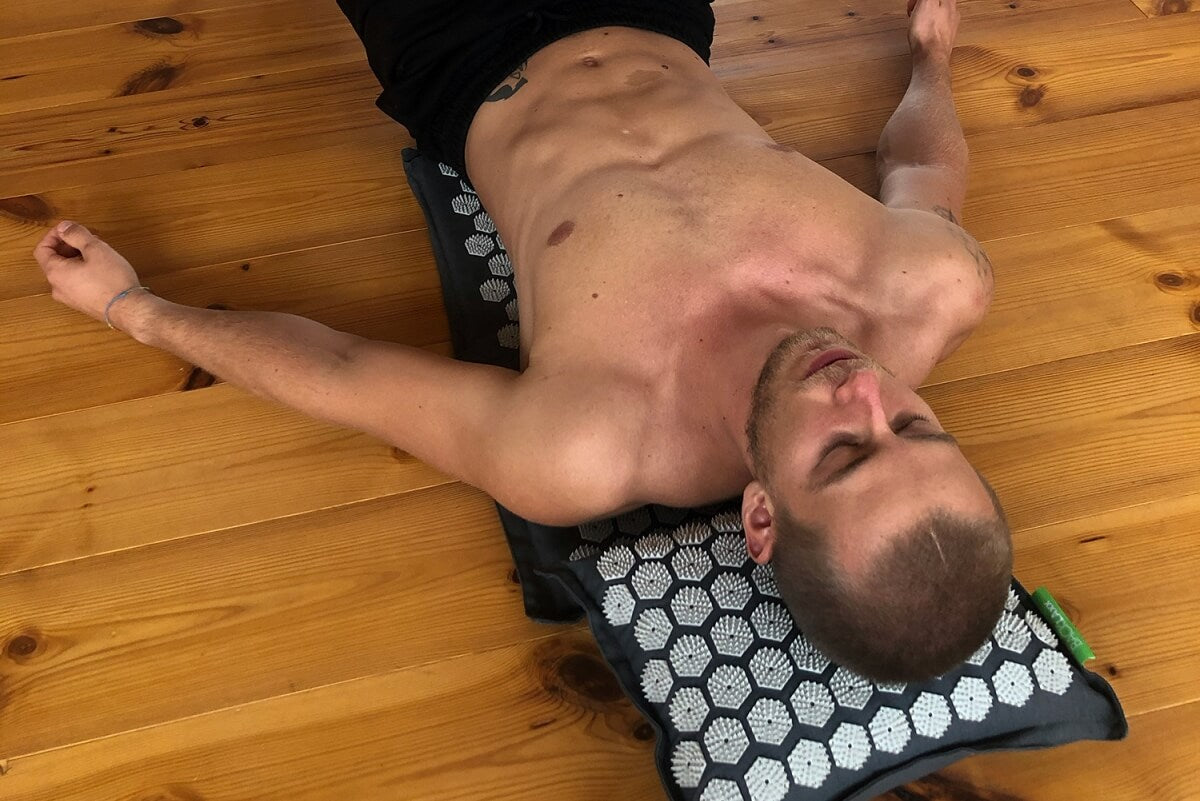
Using the acupressure mat is simple and can be done at different times and in different positions. Here's how to use the acupressure mat correctly:
- Preparation: Place the mat on a flat surface, e.g. on the floor or a bed.
- Positioning: Slowly lie on your back on the mat and find a comfortable position. Make sure the tips rest evenly on your skin.
- Variation: You can also use the mat for other areas of the body such as the neck, legs or feet.
- Regularity: Use the mat regularly to achieve lasting results.
Regular use relaxes them, loosens adhesions, and activates the body's self-healing powers. The acupressure mat also helps release endorphins, which further contribute to pain relief.
How long does it take for stuck fascia to loosen?
The time it takes for adhesions to dissolve depends on various factors, such as the severity of the adhesion, your general health, and how consistently you use the acupressure mat. With regular use, initial improvements may be noticeable after just a few days. However, complete dissolution of the adhesions can take several weeks or months.
Conclusion
If fascia is stuck, it can cause unpleasant pain and restricted movement, significantly impacting your daily life. With regular use of an acupressure mat, combined with exercise, stretching, fascia rolling, massage, a healthy diet, and stress reduction, you can effectively loosen these adhesions and restore your fascia's suppleness.
The acupressure mat is a simple yet effective method for maintaining your fascia and improving your quality of life. So, what are you waiting for? Try it out and experience for yourself how you can free yourself from stuck fascia and move freely and pain-free again!
FAQs about fascia

About the author
Roland Späht is the founder of BACKLAXX® and a content strategist. He has struggled with back pain since childhood due to scoliosis. After studying engineering, he worked for years in project management, during which time he focused intensively on treating his worsening back pain.
His goal was to fight his way out of this downward spiral of pain without medication or long-term medical treatment. Along the way, he found ways and means that permanently alleviated his pain. He firmly believes that everyone can find an alternative way out of pain.
Sources:
- Myers, TW (2022). "Anatomy Trains: Myofascial Pathways for Manual and Movement Therapists." Urban & Fischer Verlag/Elsevier GmbH
- Pfitzer T. (2021). "50 Workouts with a Fascia Roller and Ball." Riva Verlag
- Wilke J., Schleip R., Klingler W., Stecco C. (2017). "The Lumbodorsal Fascia as a Potential Source of Low Back Pain: A Narrative Review." Available at: https://onlinelibrary.wiley.com/doi/10.1155/2017/5349620 (accessed July 29, 2024).
- SGatt A., Agarwal S., Zito PM (2023). "Anatomy, Fascia Layers." In: StatPearls [Internet]. Treasure Island (FL): StatPearls Publishing. Available at: https://www.ncbi.nlm.nih.gov/books/NBK526038/ (accessed July 29, 2024).
- Schleip, R., Jäger, H., & Klingler, W. (2012). "What is 'fascia'? A review of different nomenclatures." Journal of Bodywork and Movement Therapies, 16(4), 496–502. doi: 10.1016/j.jbmt.2012.08.001. Available at: https://pubmed.ncbi.nlm.nih.gov/23036881/ (accessed July 29, 2024).
- Image sources: © 7activestudio – stock.adobe.com